
Sub-projects suck (and I have the research to prove it)
💌Newsletter
For 19 years I’ve been refusing to add sub-projects and sub-tasks to Nozbe. Customers left us over it. Many came back. Turns out four decades of research quietly agree with me…
Note: this is a transcript of the email Newsletter I sent to my 1500+ subscribers a while back. If you want to be one of them, sign up for my free Newsletter. You can unsubscribe anytime! or if you use LinkedIn, you can subscribe there, too!
🌳 The feature everybody asks for
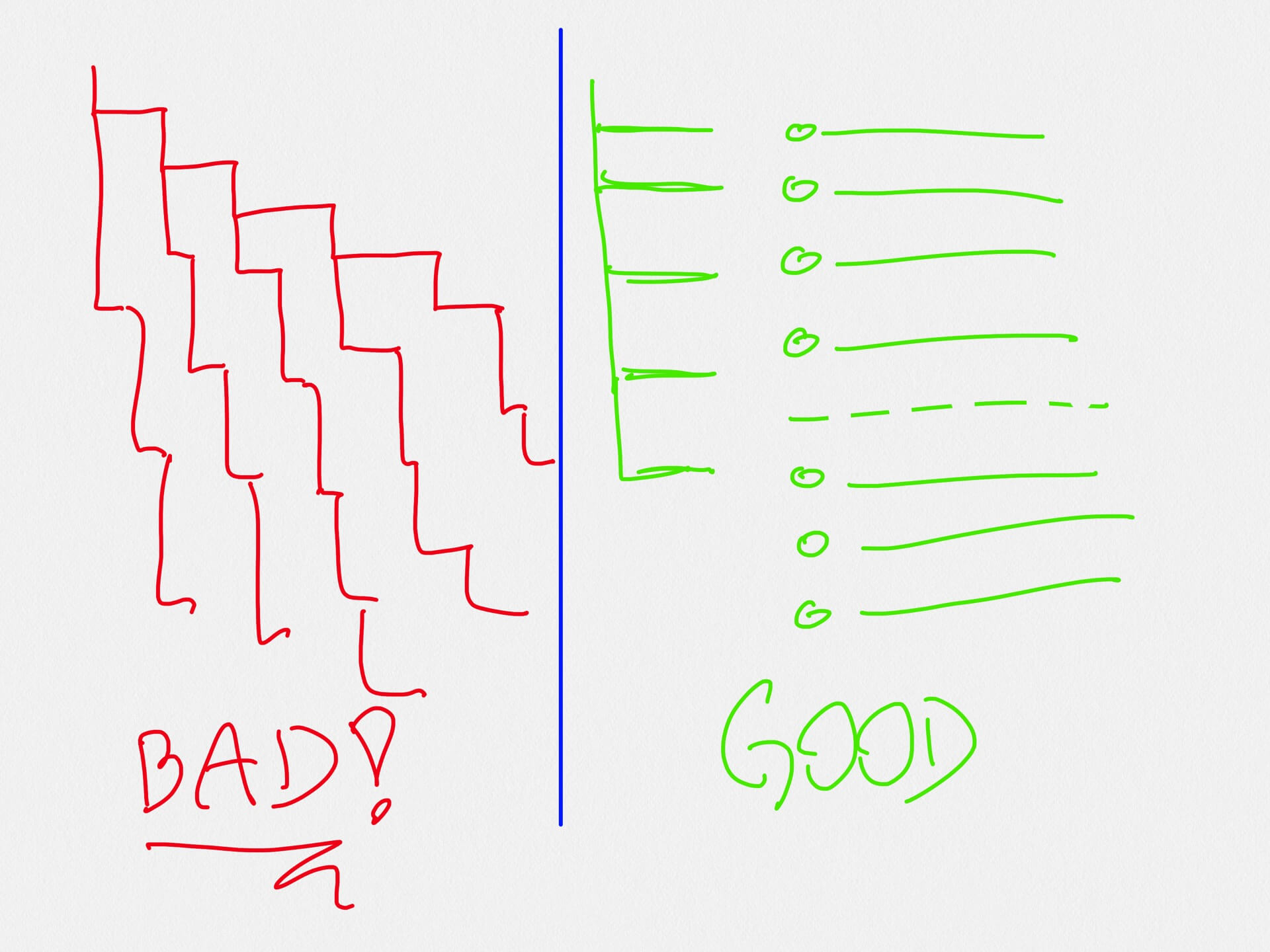
“I’d switch to you tomorrow, but you don’t have sub-projects. C’mon Michael, it’s an obvious feature you’re missing!” — I’ve heard this hundreds of times. The answer has always been NO. Not because it’s hard to build, but because I’ve watched what happens to people who get it.
🧾 A hierarchy is a decision machine
Every time you add a task: “where does this belong?” Every time you look for it: “where did I put it?” Building the structure feels like progress — it isn’t. It’s a tax you pay forever.
🐢 Deeper means slower and more wrong
Computer scientists have been testing broad and shallow versus narrow and deep since the early eighties. Kiger (1984) gave people the same 64 items arranged five ways: time and errors both went up as the structure got deeper.
⏱️ And it breaks exactly when you’re busy
Wallace, Anderson and Shneiderman (1987) put users under time pressure. The ones on the deep tree made 96% more errors and took 16% longer. Which is, let’s be honest, when you actually use your to-do app.
📁 What people do when nobody’s watching
Bergman and colleagues (2010) had 296 people retrieve their own real files from their own real computers. Average depth: 2.86 folders. Given total freedom, humans quietly go flat.
🧠 Your head holds four things — not four levels
Miller said seven plus or minus two. Cowan (2001) revised it down to about four chunks. Every level you traverse eats some of that budget — on looking for the work instead of getting it done.
🪂 Scrolling is like falling
Social media apps know this. A flat list asks nothing of your memory — gravity does the work. Digging through projects → sub-projects → tasks → sub-tasks feels like climbing.
✅ But breaking things down DOES help
Kruger and Evans (2004): listing the steps cuts the planning fallacy by more than half. And the WHO Surgical Safety Checklist (NEJM, 2009) cut in-hospital deaths from 1.5% to 0.8% — with 19 items on one piece of paper. Not a tree. A flat list.
Decomposition is good, hierarchy is not. That’s why Nozbe solves “sub-tasks” with checklists inside comments — and when a checklist outgrows itself, one click turns it into a project.
🗂️ What we give you instead
Project groups (one project can live in several groups — a tree makes you pick one) and project sections (a vertical Kanban you see in one scroll). Organization without depth.
🫵 Your turn: count the levels
Open your app, find your deepest project, count the levels. How many help you do the work — and how many just help you feel organized? Flatten one this week and hit reply to tell me how it went 🤔
P.S. Feel free to check out my full essay with all the studies and links.